


Solutions
Skilling
AI-Native Solutions
Managed Services
Custom eLearning
Products
BrinX
PersonaTrain.ai
Industries We Serve
Learning for Key Sectors

Airlines

Banking & Finance

Oil & Gas

Pharma & Healthcare

Retail

Telecom & IT
Business Areas

Global Capability Centers

Our Work
Insights
Blog
Podcast
eBooks
Position Papers
Whitepapers
L&D Myth-ology
Reports
Presentations
Case Studies
Webinars
Infographics
Newsletters
Who We Are

About Upside Learning

About Mitr Learning & Media

Leadership

Awards

Press Releases

Clients

Careers

Contact Us

Talk to Us

Learning Engagement: Proven Learner Engagement Strategies for Corporate Training

Why Engaged Learners Outperform: Learning vs. Performance

Engaged learners play a significant role in the growth of any organization. Without engagement, there is neither learning nor learning transfer to facilitate performance, the ultimate goal of workplace learning. When employees disengage from learning, the impact can extend beyond the learning experience itself and put the relevance of the L&D function at stake.

Learning without performance impact isn’t the goal. Performance is. Learning is the mechanism; performance is what it’s for.

With the Learning Engagement Go Beyond campaign, we explore the art and science of creating learning experiences that encourage employees to engage, learn, and apply what they learn at work. We look at the foundations of learning engagement, learning engagement design, and how to measure engagement, supported by real-life examples and stories.

The Two Pillars of Learner Engagement: Motivation and Practice

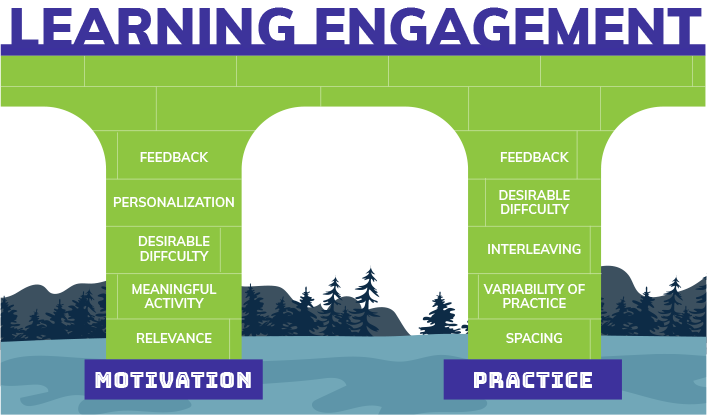
Learning science tells us that learner engagement rests on two pillars:

Learning Engagement - Two Pillars: Motivation and Practice
Motivation

Motivation is the starting point. Right from the beginning, it’s important to maintain motivation levels throughout the learning intervention with appropriate learning design.

Motivation

There is no learning without practice; there is no performance without practice. Simulations or scenarios can fill in for real situations, but practice is a must. What works best is spaced practice, staggered retrieval, and interleaving practice sessions.

How We Measure Training Engagement

We track metrics like time spent, replays, interactions, quiz attempts, click-through paths, and feedback scores, plus learning analytics tied to performance outcomes, so training engagement is never a guess.

Frequently Asked Questions

The level of focus, interest, and drive learners bring to training is known as learner engagement. High engagement leads to better retention, behavior change, and real-world application, making training actually work.
Learning is the mechanism; performance is what it's for. A performance-driven learning approach starts from the business outcome you need and works backward to the training, rather than treating course completion as the finish line.
We track metrics like time spent, replays, interactions, quiz attempts, click-through paths, and feedback scores, plus learning analytics tied to performance outcomes — the core of training engagement measurement.
Generic content, poor UX, irrelevant scenarios, information overload, and no clear application to their role are the top reasons. We design around these from the start to protect learner engagement.
Absolutely. We use behavioral consequences, branching scenarios, and narrative to humanize and give meaning to content, even in regulated subjects; see our Compliance Training solutions.
No. A completed course doesn't mean the learner was engaged or retained anything. Learner engagement measures active involvement and value perception, not just completion.
Learning Engagement

Looking to Create Engaging Learning Programs?


    Subscribe to receive updates from Upside Learning. You can unsubscribe at any time.