


Solutions
Skilling
AI-Native Solutions
Managed Services
Custom eLearning
Products
BrinX
PersonaTrain.ai
Industries We Serve
Learning for Key Sectors

Airlines

Banking & Finance

Oil & Gas

Pharma & Healthcare

Retail

Telecom & IT
Business Areas

Global Capability Centers

Our Work
Insights
Blog
Podcast
eBooks
Position Papers
Whitepapers
L&D Myth-ology
Reports
Presentations
Case Studies
Webinars
Infographics
Newsletters
Who We Are

About Upside Learning

About Mitr Learning & Media

Leadership

Awards

Press Releases

Clients

Careers

Contact Us

Talk to Us

Measuring Training Effectiveness Through
Learning Impact Metrics

Why Measuring the Business Impact of Learning Is Now an L&D Priority

However, more and more organizations are now beginning to focus on how learning initiatives can align to their business goals, and impact employee performance directly. That makes L&D a direct stakeholder in impacting businesses overall – something our entire fraternity wanted for the longest time. The question then is – are we equipped to play the part?

While learning delivery has continually evolved – keeping up with new technology and innovating on effective learning design – the measurement of the value brought in by these initiatives has largely remained a challenge.

Currently, most organizations are relying on course completion (or even learner satisfaction aka smile sheets) data as their only indicator for measuring learning effectiveness. By itself, this is insufficient and often misleading. It’s a good indicator only if it’s used as a basis for deeper analysis on how to improve the effectiveness of learning interventions.

Though organizations realize the value of more robust analytics, they often have trouble identifying the right metrics to measure the impact of their learning interventions.

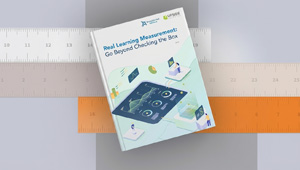
Since our GoBeyond initiative has been about nudging L&D to go beyond ‘ticking the box’ and focus on what matters most, Measuring Learning Effectiveness seemed like an area that could use some of our undivided focus.

How We Measure Learning Effectiveness: Frameworks and Metrics

We evaluate every program against established training effectiveness measurement frameworks, not a single generic scorecard:

Kirkpatrick’s Four Levels

Reaction, learning, behavior, and results

Phillips ROI Model

Building on Kirkpatrick with a fifth level focused on financial impact

Our Own Performance-Based Evaluation Model

Tuned to your specific business KPIs

The data behind these models comes from a consistent set of tracked metrics: completion rates, evaluation results, engagement metrics, application-level feedback, time to competency, on-the-job performance, and ROI indicators. Together, these provide the full picture of learning effectiveness measurement, rather than relying on a single number.

Learning Analytics Dashboards That Show Real-Time Training Effectiveness

Measurement only matters if it’s visible. Our learning analytics dashboards are designed not just to report outcomes but also to inform future design, surface learning gaps, and recommend content or strategy changes. They integrate with your LMS, LXP, or learning record store (LRS) via SCORM or xAPI to track progress, scores, and behavioral outcomes as they happen.

Frequently Asked Questions

It's the process of determining whether a learning program is producing its intended outcomes, such as improved job performance, changed behavior, knowledge retention, and alignment with business KPIs, rather than simply measuring whether people completed it.
We start by aligning training goals with KPIs, then combine surveys, assessments, management feedback, and system data (sales, compliance, productivity) to track real training effectiveness, not just course completion.
We apply the Phillips ROI Model by comparing the monetary value of training benefits, such as productivity gains, error reduction, and retention, against the total program cost. This ensures eLearning ROI is expressed as a measurable figure that leadership can act on, rather than a vague impression.
Our learning analytics dashboards are built to inform future design, not just report a score. They identify learning gaps and recommend content or strategy changes as new data comes in.
Yes. We offer measurement frameworks and post-training analysis tools, including surveys, assessments, 360-degree feedback, and dashboards, even for non-digital or already-delivered programs. This allows you to retroactively assess training effectiveness.
Lack of defined metrics, disconnected systems, limited follow-up, and difficulty tying behavior change to business outcomes are the most common. We address these with structured frameworks rather than a one-size-fits-all scorecard, which is at the heart of measuring business impact of learning.
Measuring Learning Effectiveness

Looking to Measure your
Learning Outcomes?

Tell us what you’re currently tracking (or not tracking), and we’ll help you build a training effectiveness measurement plan that ties directly to business outcomes.


    Subscribe to receive updates from Upside Learning. You can unsubscribe at any time.