


Solutions
Skilling
AI-Native Solutions
Managed Services
Custom eLearning
Products
BrinX
PersonaTrain.ai
Industries We Serve
Learning for Key Sectors

Airlines

Banking & Finance

Oil & Gas

Pharma & Healthcare

Retail

Telecom & IT
Business Areas

Global Capability Centers

Our Work
Insights
Blog
Podcast
eBooks
Position Papers
Whitepapers
L&D Myth-ology
Reports
Presentations
Case Studies
Webinars
Infographics
Newsletters
Who We Are

About Upside Learning

About Mitr Learning & Media

Leadership

Awards

Press Releases

Clients

Careers

Contact Us
Talk to Us
Report

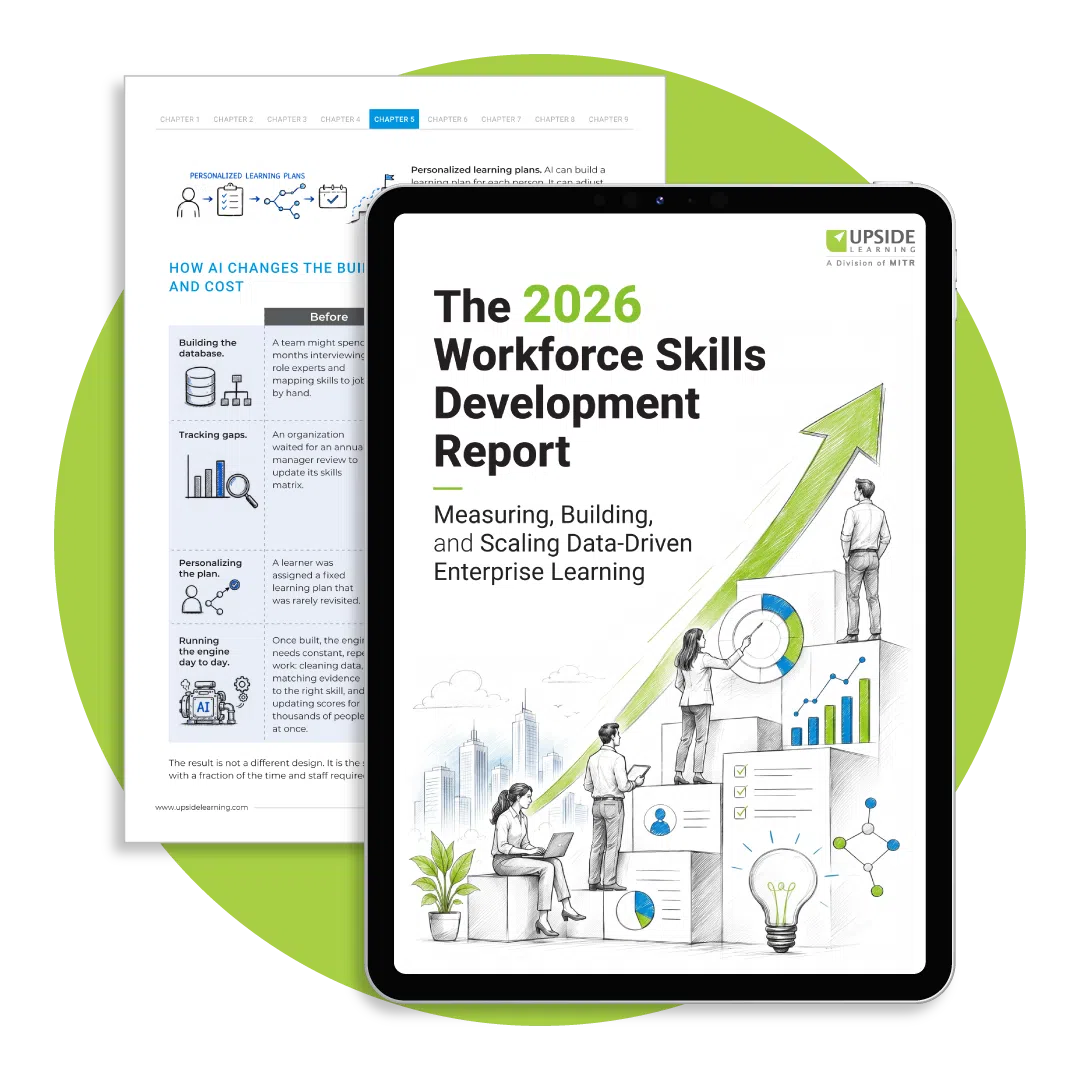
The 2026 Workforce Skills Development Report: Measuring, Building, and Scaling Data-Driven Enterprise Learning

What Is Included in the Download

The five-level Skilling Maturity Spectrum to identify your organization's current stage
The strategic approach behind high-performing workforce skills development programs
A practical framework for measuring L&D ROI using business metrics your board already understands
The Skills Intelligence Engine: the architecture behind building workforce capability at scale.
What Is Included in the Download

9

Chapters

6

Industries

9

Case Studies

Free

Download

Instant

Access

What Is in the Report

Nine chapters. One clear argument: the skills gap is a design problem, not a spend problem.

Executive Summary

The 2026 Workforce Skills Development Report: Measuring, Building, and Scaling Data-Driven Enterprise Learning

The five major findings, key recommendations, and how to get the most from the report before exploring each chapter.

Chapter 1

The Skills Gap Is Not New, but the Stakes Have Changed

Why the skills gap persists despite growing training investment. The five-level Skilling Maturity Spectrum. What Level 1 through 5 actually looks like inside real organizations.

Chapter 2

The Skills Gap: Where Enterprises Stand Today

Why most skills development programs fail before they start. The system barriers, gatekeeping patterns, and hidden costs holding enterprise L&D back.

Chapter 3

How High-Performing Organizations Build Skilling Programs

The Will, Skill, Hill diagnostic. The Capability Academy model. Three anonymized cases showing what high-performing L&D teams prioritize to succeed.

Chapter 4

Learning ROI and Business Impact of Skilling

The Business Performance Linkage Model. Measure and report the impact of skills development initiatives in language that boards understand and trust.

Chapter 5

AI-Powered Skilling: Building and Implementing the Skills Intelligence Engine

The six-layer architecture behind a real skills-focused L&D operation. How AI changes the build timeline, resource requirements, and cost. What still requires human judgment.

Chapter 6

AI-Powered Content: Managing and Developing Learning Assets at Scale

How to audit existing content against your skills taxonomy. The build, buy, borrow, automate decision. AI role plays and simulations. Content orchestration versus course production.

Chapter 7

Leadership and Manager Collaboration: The Multiplier Effect

Why manager involvement is the multiplier that determines whether any program holds. The ADKAR model and its value. The Atoms and Molecules analogy for understanding what it really takes to build capabilities.

Chapter 8

Workforce Reskilling at Scale: From Pilot to Enterprise-Wide

What changes when a pilot succeeds and demonstrates impact before scaling up to cover tens of thousands of people.

The 90-day sequencing model.

Chapter 9

Recommendations and the Skills Intelligence Engine Maturity Scorecard

The Skills Intelligence Engine Maturity Model. Recommendations by maturity level. A self-assessment scorecard and a prioritized 90-day action framework.

Who Should Read This Report?

Heads of Learning & Development

You design and deliver workforce skills development programs that need to improve workforce performance, not just learning completion.

Chief Learning Officers

You need to demonstrate business impact and justify learning investment with evidence that earns executives' trust.

CHROs and HR Leaders

You are accountable for workforce readiness and need a credible framework for connecting workforce skills development investment to business strategy.

Five Findings Every L&D Leader Should Know

01

Most organizations have training activities. They do not have a skilling operation. The gap between the two is a design gap, not a technology gap.

02

Bad skills data is the root cause most programs never fix. A spreadsheet updated once a year cannot support a real skilling operation.

03

High-performing organizations diagnose before they design. They invest only where learning is the right solution.

04

Only 8 percent of L&D professionals can confidently measure real business impact. The fix is choosing the right metric before the program starts.

05

Manager involvement before launch, not at launch, is the single variable that determines whether a program sustains its gains.

Enterprise Insights Across Six Industries

The report draws on anonymized enterprise cases and practitioner research across six industries, plus Global Capability Centers (GCCs).

About the Author

Venudhar Bhatt

Venudhar Bhatt

Thought Leader in Workforce Skilling and Enterprise Learning at Upside Learning

LinkedIn

Venudhar Bhatt is a practitioner and researcher in workforce skilling and enterprise learning, with more than two decades of experience leading capability transformation initiatives across global enterprises. He is the creator of the Skills Intelligence Engine architecture, the Will, Skill, Hill diagnostic framework, and the Atoms and Molecules model for capability development.

He is a Thought Leader at Upside Learning, where he partners with enterprise L&D and HR leaders to design, build, and scale skilling systems that connect workforce capability development to measurable business outcomes.
This report presents Venudhar’s original research and frameworks, informed by work across organizations in aviation, financial services, oil and gas, retail, pharmaceuticals, and Global Capability Centers (GCCs).

Download

Download the Report


    Subscribe to receive updates from Upside Learning. You can unsubscribe at any time.

    By downloading this report, you agree to receive occasional updates from Upside Learning. Unsubscribe at any time.

    Frequently Asked Questions

    Yes. It's free to download. No credit card. No trial. Just three form fields.
    The report was researched and written by Venudhar Bhatt, a Thought Leader at Upside Learning. It presents his original research, frameworks, and models alongside established approaches and anonymized case narratives constructed from enterprise patterns.
    No. The report is a practitioner-led research document. Upside Learning's services are referenced only in the closing section of Chapter 9.
    Explore

    More Reports from Upside

    Discover more enterprise learning reports and industry research.

    View All Reports