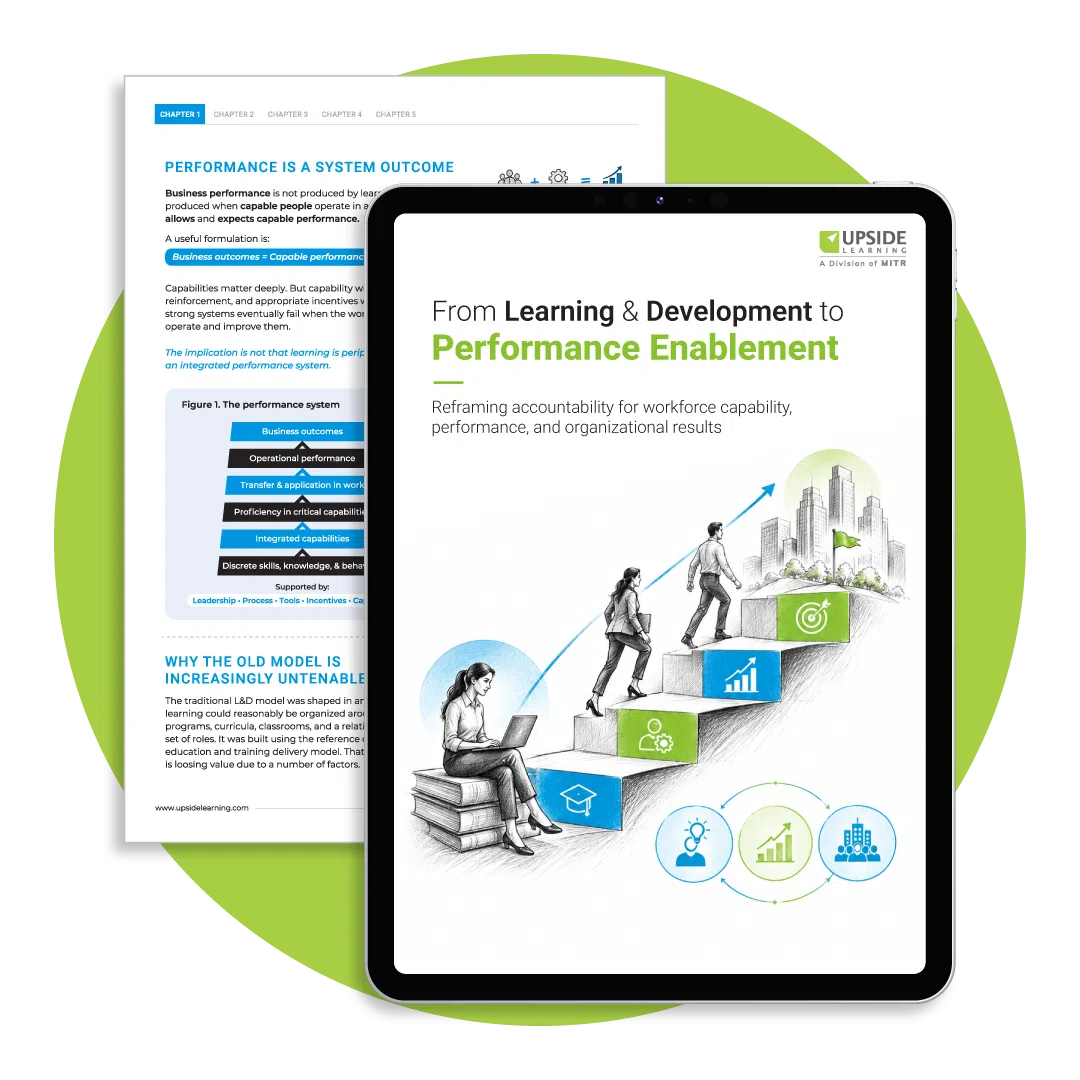
This report examines the shift from a course-centric L&D operating model to a Performance Enablement function with a defined business mandate.
It explores:
5
Chapters
6
Core Accountabilities
4
Ecosystem Layers
5
Evidence Levels
Free
Report Download
Understand why changing the name of L&D or reporting more business metrics will not resolve the limitations of its traditional operating model. Explore the need to redefine its purpose, accountability, activities, technology, and organizational expectations.
Examine the limitations of the traditional request-response model, the seat-at-the-table paradox, and the difference between learning activity and actual workforce readiness.
Understand why performance problems cannot automatically be treated as training requirements and why business outcomes depend on more than learning interventions.
Explore the capability-value chain connecting discrete skills, integrated capabilities, demonstrated proficiency, workplace performance, and business outcomes.
Understand why workforce capability needs to be managed as an organizational asset and how responsibility should be divided between Performance Enablement and functional leaders.
Explore the six core accountabilities of Performance Enablement, including capability strategy, performance diagnosis, development experience design, proficiency measurement, learning intelligence, and enterprise capability insight.
Understand the performance diagnosis framework and the hub-and-spoke operating model that balances enterprise-wide standards with functional relevance.
Discover the four layers of a Learning Intelligence Ecosystem and how they connect skills intelligence, development experiences, evidence, analytics, technology, and governance.
Explore the role of AI in personalized development, adaptive assessments, AI-guided practice, and performance support, alongside the importance of human judgment, data quality, privacy, and trust.
Explore the five-level Performance Enablement scorecard, from reach and experience to business outcomes.
Understand how to measure proficiency and workplace transfer, distinguish contribution from causation, assess attribution confidence, and build a leadership dashboard that supports better decisions.
The report provides a framework for understanding what it takes to redesign L&D around workforce capability rather than learning delivery.
You will gain clarity on:
Establish what Performance Enablement should own, what it should share with the business, and what remains the responsibility of functional and executive leaders.
Translate organizational strategy into capability requirements, role expectations, underlying skills, and proficiency standards.
Determine whether a capability gap exists or whether process, technology, leadership, incentives, or capacity are preventing effective performance.
Select development experiences that help employees build capabilities and use them in real work situations.
Connect workforce capability data, learning experiences, assessments, and operational evidence through a Learning Intelligence Ecosystem.
Establish evidence of capability development, transfer, and operational contribution without attributing every business result to learning.
Understand how to move beyond course production and activity reporting towards ownership of workforce capability development, proficiency, and learning intelligence.
Explore the operating model, governance, investment priorities, and accountability structure required to position Performance Enablement as an internal business function.
Understand how workforce capability can be connected to organizational strategy, critical roles, talent requirements, and workforce readiness.
Clarify the role of business leaders and managers in defining capability requirements, creating opportunities for practice, reinforcing behaviors, and enabling workplace application.
Explore practical frameworks for capability mapping, performance diagnosis, development experience design, proficiency measurement, and learning intelligence.
Thought Leader in Workforce Skilling and Enterprise Learning at Upside Learning
LinkedInVenudhar Bhatt serves at the intersection of learning science and technological innovation, driving the vision for next-generation learning and educational services at Mitr and Upside Learning. As a leader in the learning engineering domain, Venudhar is committed to advancing thought leadership that challenges the status quo, moving beyond content delivery to focus on true performance outcomes.
In his association with Upside Learning, Venudhar leads strategic consulting and product architecture to help UL’s customers and partners solve their most pressing challenges.
Venudhar Bhatt believes that the next era of learning belongs to those who can masterfully balance human-centric design with the power of artificial intelligence to create truly transformative learning experiences.
By downloading this report, you agree to receive occasional updates from Upside Learning. Unsubscribe at any time.
Discover more enterprise learning reports and industry research.
View All Reports